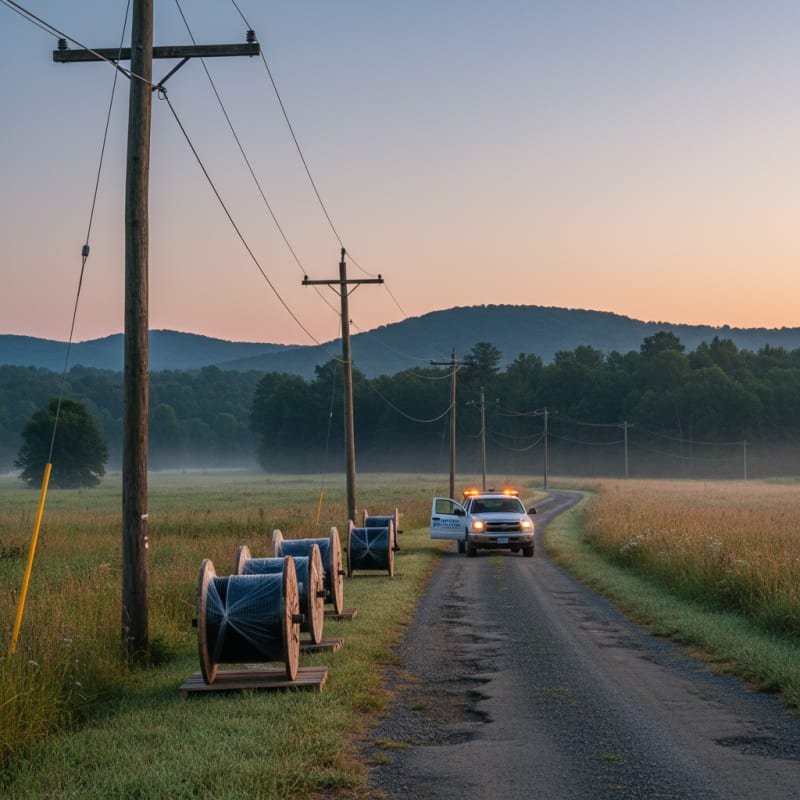
Pole attachment disputes in Virginia are not a utility company problem. They are a contractor pipeline problem. If Governor Spanberger does not act, BEAD-funded builds in Virginia stall before your crews ever show up.
What Is Actually Being Asked Here
A Virginia Democrat is pushing Governor Spanberger to use existing state authority to resolve pole attachment disputes blocking broadband deployment. BEAD (Broadband Equity, Access, and Deployment) is the $42.5 billion federal program funding rural broadband builds across every state. Virginia has received its allocation. The money is not the problem.
Pole attachment is. When an ISP needs to run fiber on a utility pole, it has to get permission from the pole owner, usually an electric utility or telecom incumbent. That process can drag for months. Sometimes years. The ISP cannot build. You cannot work.
The argument being made is simple: the governor does not need new legislation. Existing rules already give the state tools to move pole owners faster. Use them.
Why This Lands on Your Desk Right Now
Virginia's BEAD program is in the subgrantee award phase. Subgrantees are the ISPs that win state BEAD dollars and then hire telecom contractors to do the actual build. If those ISPs cannot get pole access, they cannot finalize construction plans. If they cannot finalize plans, they cannot put work out to bid. Your pipeline sits empty while the dispute runs its course.
No timeline has been set, and no officials beyond Spanberger have been named publicly. What is confirmed: the dispute is live, the ask is on the governor's desk, and Virginia's BEAD deployment schedule depends on the answer.
The Call You Have to Make
If you are bidding or planning to bid on Virginia BEAD work, here is the question on your desk this week: how much of your projected pipeline depends on aerial builds where pole access is unresolved?
Two things to do right now.
- Talk to your ISP contacts in Virginia. Ask them directly which project areas have confirmed pole access and which are still pending. Do not assume make-ready is done.
- Look at your backlog. If aerial Virginia work is in your 90-day projection, flag it as contingent. Do not staff or finance against it until pole access is confirmed in writing.
This is not pessimism. It is working capital discipline. A 10-crew aerial operation that hires two crews ahead of a stalled job eats roughly $60,000 to $80,000 in labor costs before the first strand goes up. That is a cash flow hit you cannot invoice your way out of quickly.
What a Resolution Would Actually Unlock
If Spanberger uses existing authority to accelerate pole attachment approvals, Virginia moves. ISPs get construction-ready faster. Work orders go out. You can bid with confidence.
That is the upside worth watching. Pole access is almost always the longest lead-time item on aerial builds. Contractors who track this dispute and are ready to mobilize when it clears will win the early bids. Contractors who wait for press releases will be chasing capacity at the same time as everyone else.
Keep eyes on this one. The mechanism for resolution already exists. The only question is whether the governor uses it.
If you want a breakdown of how BEAD subgrantee timelines affect contractor bidding windows, that is what The Splice covers every week.
Pole access is not a utility problem. It is a contractor cash flow problem wearing a utility hat.
Get BEAD updates before the trade press writes them up.
The Splice decodes federal funding intel for crews and ops, not policy folks. Action items, not summaries. One five-minute read a week. Free.
Get this coverage first in Google