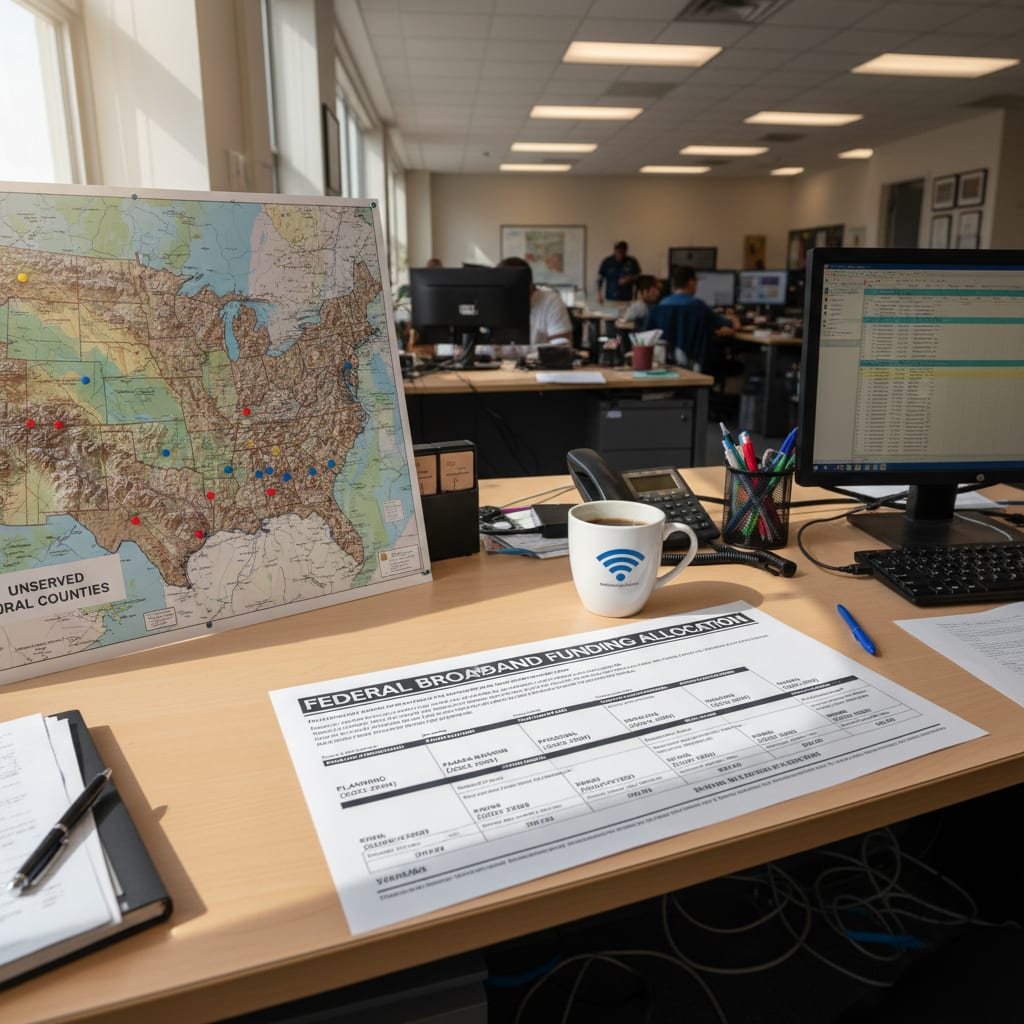
There are $21 billion in broadband deployment funds sitting frozen at the Department of Commerce. House Democrats say that is not savings. It is a broken promise. The fight between lawmakers and Commerce is now public, and if you run crews that depend on BEAD work, this dispute lands directly on your schedule.
What Is Actually Being Argued Over
BEAD stands for Broadband Equity, Access, and Deployment. Congress authorized $42.45 billion in 2021 to connect unserved and underserved areas, primarily through state-level programs. States apply to the National Telecommunications and Information Administration (NTIA), which sits inside the Department of Commerce, to access their share.
The dispute is over roughly $21 billion that has not moved to states. Commerce, under the current administration, has characterized these unspent funds as "taxpayer savings." House Democrats are pushing back hard on that framing, calling it a misrepresentation of what Congress authorized.
The full text of the challenge and the complete list of lawmakers behind it have not been published. What is confirmed: this is a formal congressional challenge, not a social media argument. Lawmakers are pressing Commerce directly over why the money is not flowing.
What This Means for Your Pipeline
If you are waiting on a state BEAD award to turn into a real subgrant agreement and a work order, this fight is why your phone is quiet.
States cannot finalize contracts with internet service providers (ISPs) until NTIA releases their funds. ISPs cannot commit to deployment schedules without those contracts. Telecom contractors do not get mobilization calls without deployment schedules. That chain stops the moment federal dollars freeze at the top.
Here is the call you have to make this week: do you hold capacity for BEAD work that has no confirmed start date, or do you redirect crews toward commercial and municipal work that pays now?
Every contractor I have seen hold idle capacity for a delayed government program eventually makes the same painful trade. You bleed working capital waiting. Then the work comes in a rush, you are understaffed, and margins collapse under the scramble. Neither end of that is good.
What the Congressional Push Does and Does Not Do
Lawmakers pressing Commerce creates pressure. It does not release funds. Congress can hold hearings, send letters, and issue formal demands. Unless Commerce changes course or a court orders otherwise, the money stays frozen until the administration decides to move it.
That said, formal congressional pressure has moved federal agencies before. The attention raises the political cost of continued inaction. Watch whether NTIA responds with a timeline or stays silent. Silence means the freeze holds. A timeline, even a vague one, means states can start planning again.
What to Watch in the Next 60 Days
Three things matter right now:
- Whether NTIA issues any public statement in response to the congressional challenge
- Whether your state broadband office signals any change in their expected award timeline
- Whether Commerce formally reclassifies the frozen funds in a budget document, which would make the freeze harder to reverse
Call your state broadband office. Not to complain. To ask one question: has anything changed in the last 30 days on federal fund release? Their answer tells you whether to hold or redirect.
The Broader Picture for 2026 Deployment Timelines
BEAD was already running two to three years behind the original deployment timeline many contractors expected. A funding freeze on top of that delay means realistic ground-breaking for BEAD-funded projects in most states has moved from 2025 expectations to a best case of late 2026 or 2027.
Build your 2026 revenue plan around work that does not depend on federal fund release. Treat BEAD as upside, not base load. If the money flows sooner, you mobilize fast. If it does not, your crews stay busy and your line of credit stays healthy.
This breakdown runs weekly in The Splice. If you are not subscribed, that is the fix.
Plan your base around work you can invoice today. Treat BEAD as the bonus, not the budget.
Get BEAD updates before the trade press writes them up.
The Splice decodes federal funding intel for crews and ops, not policy folks. Action items, not summaries. One five-minute read a week. Free.
Get this coverage first in Google