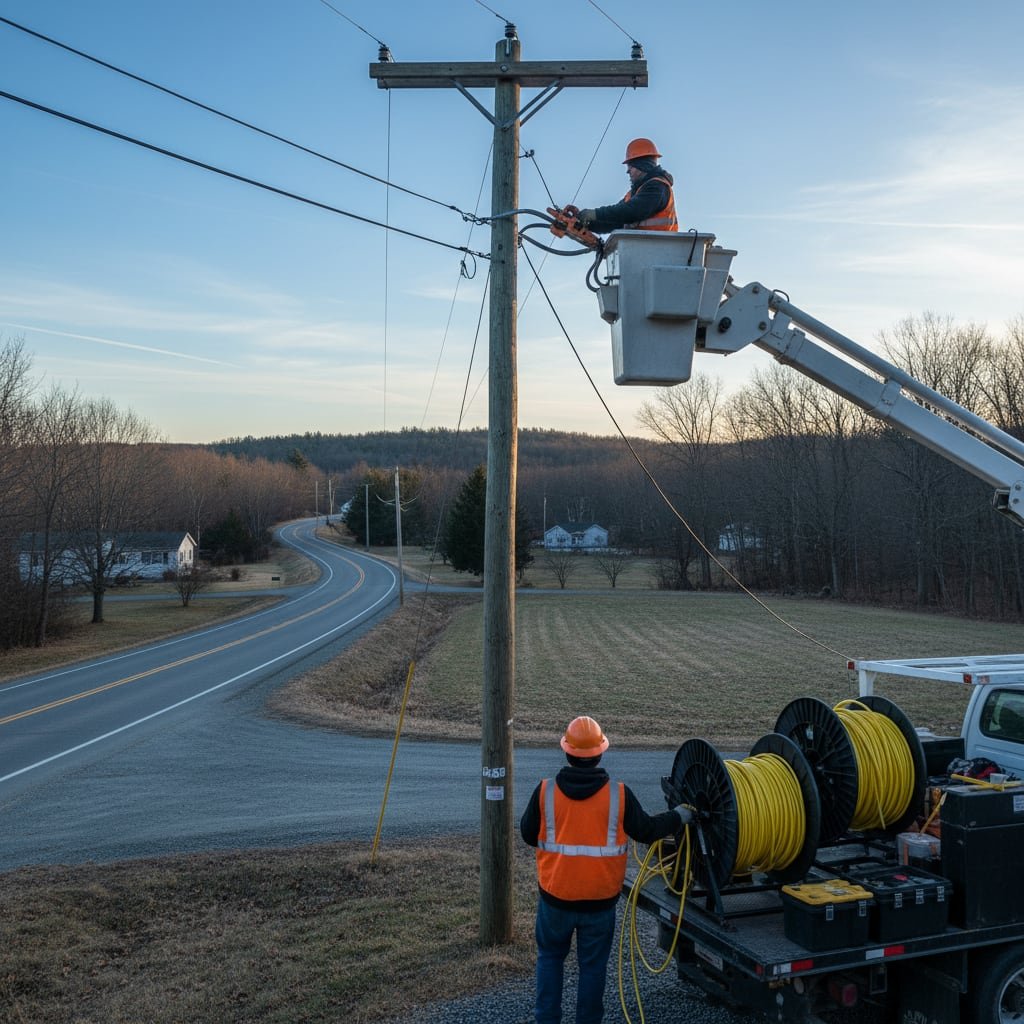
The copper pulldown is moving faster than many contractors have planned for. The FCC approved Verizon's request to discontinue legacy copper service across eight states later this year. AT&T and Fidium are filing similar requests. That's not a trend. That's a schedule.
What ISPs Are Actually Doing
Verizon got FCC sign-off to kill legacy copper service in eight states before the end of 2026. AT&T and Fidium are in line with their own discontinuation requests. When carriers file these, they're not asking permission to think about it. They're closing out a technology. Every copper line that goes dark gets replaced with fiber, wireless, or nothing. Two of those three outcomes mean work for telecom contractors.
The ISPs doing this aren't shrinking. They're migrating. And every migration needs boots on the ground to pull the new drop, splice the fiber, and close the job.
Where Your Pipeline Sits in This Shift
Here's the call you have to make right now. If your regional ISP clients are Verizon partners, AT&T subgrantees, or Fidium affiliates, copper discontinuation is a forcing function. It accelerates fiber deployment timelines that might have felt theoretical a year ago.
Picture aerial contractors running mixed copper and fiber work when the carrier flips a market. Fiber volume can jump fast. The contractors with capacity already in place capture it. The ones still figuring out crew counts miss the window.
This is the question on your desk this week: do your current ISP clients have copper markets in their service areas? If yes, ask them directly where those markets are in the discontinuation queue. That conversation will tell you more about your 2027 pipeline than any forecast spreadsheet.
What the Back Office Has to Be Ready For
Accelerated deployments compress everything. MSAs that worked fine for steady-state fiber rollouts get tested when carriers push volume fast. Your draw schedule, your lien waiver process, your COI updates, all of it gets stress-tested when a carrier decides to move a market off copper in 120 days instead of 18 months.
Watch your WIP closely during a ramp. Working capital burns faster than many operators expect when crew hours spike before invoice cycles catch up. DSO doesn't shrink just because the job count doubles. If anything, it stretches, because the carrier's back office is also scrambling.
Get your AR aging report in front of you now, before the ramp, not during it. Know your line of credit ceiling. Talk to your banker before you need the draw, not after.
The Longer Play
Copper discontinuation isn't happening in isolation. BEAD deployments (the federal Broadband Equity, Access, and Deployment program that's distributing $42.45 billion across all 50 states) are already stacking up behind the carrier-driven fiber push. When both hit the same labor market at the same time, crew availability gets tight fast.
Carriers know this. The ones moving now on copper are partly trying to get ahead of the labor crunch that hits when BEAD construction scales in 2027 and 2028.
If you're positioned with the right ISP relationships and you've got your operational house in order, this is a moment to grow. If you're running thin on foremen, carrying old equipment, or still reconciling jobs out of a truck binder, the ramp will find every gap.
The Splice covers these shifts every week so you're not catching up. Subscribe to stay positioned.
When carriers close out a technology, they're publishing your next two years of work. Read the filing.
Get BEAD updates before the trade press writes them up.
The Splice decodes federal funding intel for crews and ops, not policy folks. Action items, not summaries. One five-minute read a week. Free.
Get this coverage first in Google