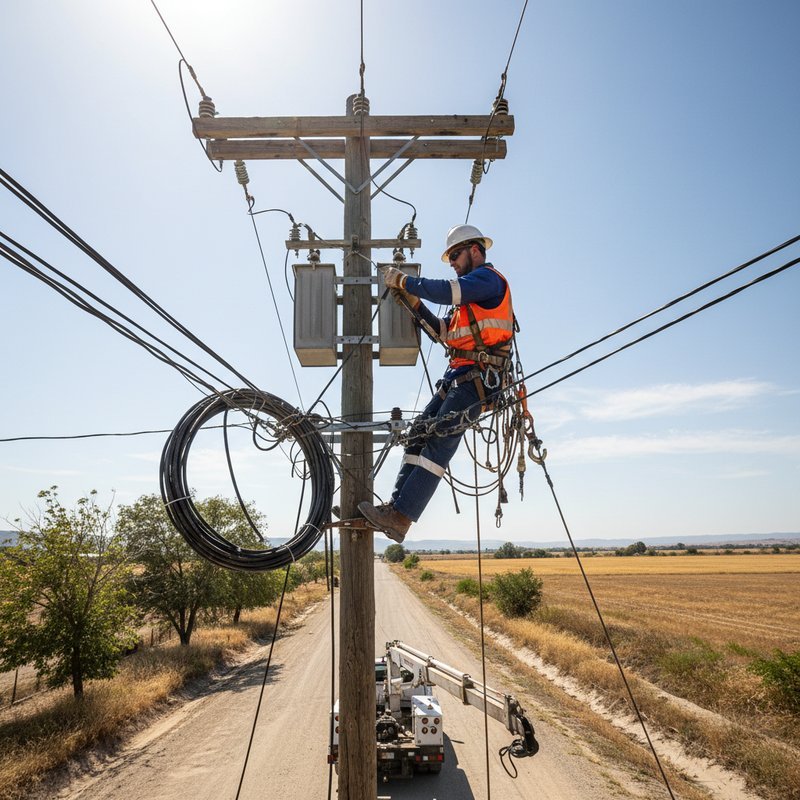
Pole work is about to become the most expensive single line item in BEAD deployment. A new analysis from the Advanced Communications Law and Policy Institute projects that pole-related costs across BEAD projects could reach $4.6 billion, tied to roughly 3.9 million utility-owned poles. If your crews do aerial work, this number lands on your desk today.
What the $4.6 Billion Number Actually Means for Your Work
BEAD (Broadband Equity, Access, and Deployment) is the $42.45 billion federal program run through NTIA, the National Telecommunications and Information Administration. States receive grants and then award subgrants to ISPs. Those ISPs hire telecom contractors to build the last mile. And the last mile, in most rural states, runs on poles.
The analysis comes from ACLP researchers Alex Karras and Michael Santorelli. Their headline figures: roughly 3.9 million utility-owned poles are expected to be touched by BEAD buildout, with total pole costs projected at $4.6 billion. Read the ACLP paper directly if you need the cost per pole methodology.
At scale, that is roughly $1,179 per pole on average if costs were evenly distributed. They will not be. Pole make-ready costs, the work done to prepare a pole before new cable can attach, vary by region, pole owner, and congestion. In some corridors, make-ready runs $500 per pole. In others, especially where poles carry multiple third-party attachments already, costs run well past $3,000.
The Bottleneck Is Not Fiber. It Is Pole Access.
Here is the call you have to make as an aerial contractor right now: are you positioned to move fast when make-ready orders open, or are you waiting on someone else's timeline?
Pole make-ready is a known choke point. ISPs often cannot pull permits, finalize routes, or issue notices to proceed until pole surveys are done and make-ready is cleared. That sequence can take six to eighteen months in congested corridors. When it breaks loose, it breaks loose fast. Crews that are already qualified, bonded, and on the approved vendor list get the call first.
If you are not already on your primary ISP customer's approved list for make-ready work, that conversation needs to happen this month. Not when the notice to proceed lands.
Working Capital Is the Hidden Risk in Pole Work
Pole make-ready billing can be slow. The utility bills the ISP. The ISP reconciles against the project budget. The telecom contractor waits. I have seen DSO, days sales outstanding, stretch past 75 days on make-ready-heavy projects. That kills working capital fast on a 10-crew aerial operation running weekly payroll.
Before you commit capacity to a BEAD aerial buildout, run the math on your AR aging. If your line of credit does not cover four to six weeks of crew costs on top of your current draw, you need to either tighten payment terms upfront or build a cash reserve before crews roll.
One aerial contractor we work with, running eight crews in the Southeast, learned this after their first BEAD-adjacent project. Make-ready invoices sat 62 days while payroll ran every Friday. They pulled through but burned their entire line of credit doing it. The fix was a two-week billing cycle written into the next contract before signing, not after.
What to Do Before BEAD Make-Ready Moves in Your State
- Confirm which utility companies own poles in your primary work counties. Contact their attachment offices now.
- Get your crews trained and certified on any utility-specific make-ready requirements. Some utilities require separate pre-qualification.
- Ask your ISP customers directly: what is their pole survey status and expected make-ready start window?
- Review your contract language on billing cycles and payment terms for make-ready work specifically.
- Check your line of credit headroom against a scenario where invoices sit 60 days on your next project.
The $4.6 billion number is not a budget line in Washington. It is the aggregate of thousands of individual pole jobs that will land on aerial contractors across 50 states over the next three years. Some of that work will go to contractors who are ready. The rest will sit in queue.
For the full breakdown on BEAD state timelines and how to position your operation before notices to proceed land, subscribe to The Splice.
Pole access is not a permitting problem. It is a preparation problem, and preparation starts before the project does.
Get BEAD updates before the trade press writes them up.
The Splice decodes federal funding intel for crews and ops, not policy folks. Action items, not summaries. One five-minute read a week. Free.
Get this coverage first in Google