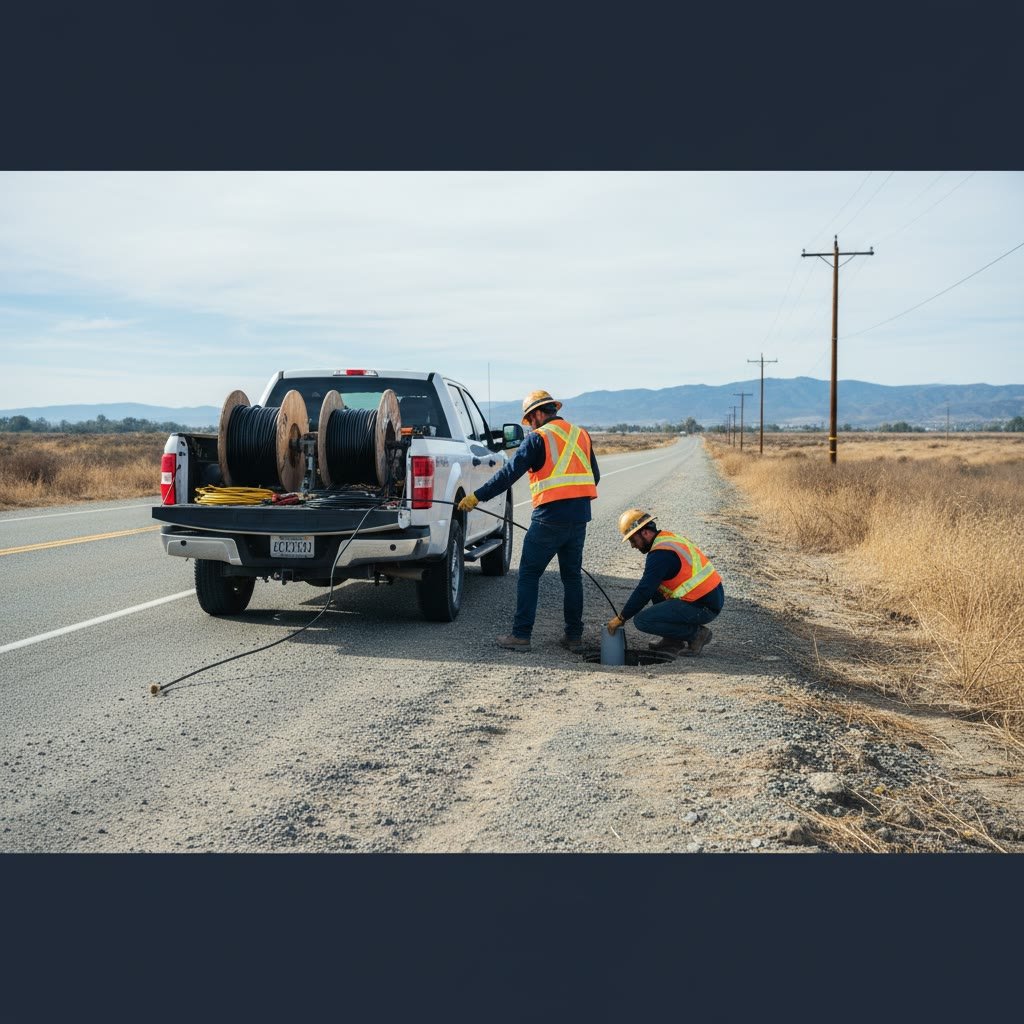
The Golden State Connect Authority just put 1,065 miles of rural California fiber into motion. FiberTel has the design-build contract. Early 2027 is the groundbreaking target for remaining projects. Here's the question on your desk this week: are you positioned to work in those counties, or are you watching from the outside?
What Just Happened and Why It Signals Real Work
GSCA, a joint powers authority representing 40 rural California counties, signed a design and construction agreement with FiberTel on September 4, 2026. FiberTel, a Quanta Services company, will design and build last-mile fiber in Alpine, Amador, Imperial, Mono, and Tehama counties, plus the Town of Mammoth Lakes. They'll also finish Phase 2 in Glenn County, where GSCA broke ground on Phase 1 in April 2026.
This isn't a grant application or a planning study. It's a signed contract with a named builder and a construction schedule. GSCA expects to break ground on remaining projects and start connecting residents and businesses in early 2027.
The money behind it: $110.9 million in bond financing and $185.4 million from the California Public Utilities Commission's Last Mile Federal Funding Account. That's $296.3 million committed to a single network buildout across rural California.
The Open-Access Structure Changes the Contractor Picture
GSCA owns the infrastructure. Multiple broadband providers ride on top of it. That open-access model, where one public entity builds the pipes and private ISPs compete on the network, tends to create more contractor entry points than a single-carrier rollout.
When a private carrier builds, they control the whole supply chain. When a public authority builds, the prime contractor needs support crews, and those primes are often required to demonstrate local hiring and spread work across the region. FiberTel will carry the design-build prime role, but 1,065 miles across six counties in California's rural terrain isn't one crew's job. Alpine County sits in the Sierra Nevada. Tehama County runs from the Sacramento Valley into the foothills. Imperial County borders Mexico. These are hard builds with variable terrain, and big primes use regional capacity to hit schedules.
Here's the call you have to make: do you have a relationship with FiberTel or Quanta Services today, or are you starting from zero when the RFQs drop?
What You Should Be Doing Before Early 2027
Groundbreaking is roughly four months out. That sounds like plenty of time. It isn't, if you're waiting for the work to find you.
- Get your prequalification docs current. Quanta-affiliated primes run formal vendor qualification processes. Insurance certificates, bonding capacity, safety records, and crew counts need to be on file before the first RFQ drops. A COI that expired last quarter kills a bid.
- Map your county reach. If you're based in the Central Valley, Tehama and Glenn are natural fits. If you're in Southern California, Imperial is your county. Don't chase every project. Pick the ones where your drive time and crew staging make sense.
- Check your working capital position now. Public authority jobs often pay on 30-to-45-day net terms, sometimes longer. If your AR aging already has invoices sitting past 45 days, adding a large public job without a credit line to bridge the gap puts your crew payroll at risk. Know your DSO before you commit to a bid.
- Verify your California contractor license. Class C-7 (low voltage) or Class A (general engineering) work, depending on scope. If your license lapsed or you're out of state, the clock to reinstate is longer than contractors expect.
The Bigger Pattern Worth Tracking
GSCA's model is replicable. Forty counties built a joint powers authority, secured public financing, and put a Quanta company in the prime seat. Other rural county coalitions in California and across the West are watching this. If the Glenn County Phase 1 build delivers on schedule, expect similar structures in other states looking for a template that doesn't depend on a single private carrier.
That means the contractors who build a track record on these open-access public builds now are the ones who'll see the next round of RFQs first.
We cover BEAD state plans, public-private broadband deals, and what they mean for telecom contractors every week in The Splice. Subscribe below to get the next issue before the market does.
The contractors who show up before the RFQ drops are the ones who get on the bid list.
Get BEAD updates before the trade press writes them up.
The Splice decodes federal funding intel for crews and ops, not policy folks. Action items, not summaries. One five-minute read a week. Free.
Get this coverage first in Google